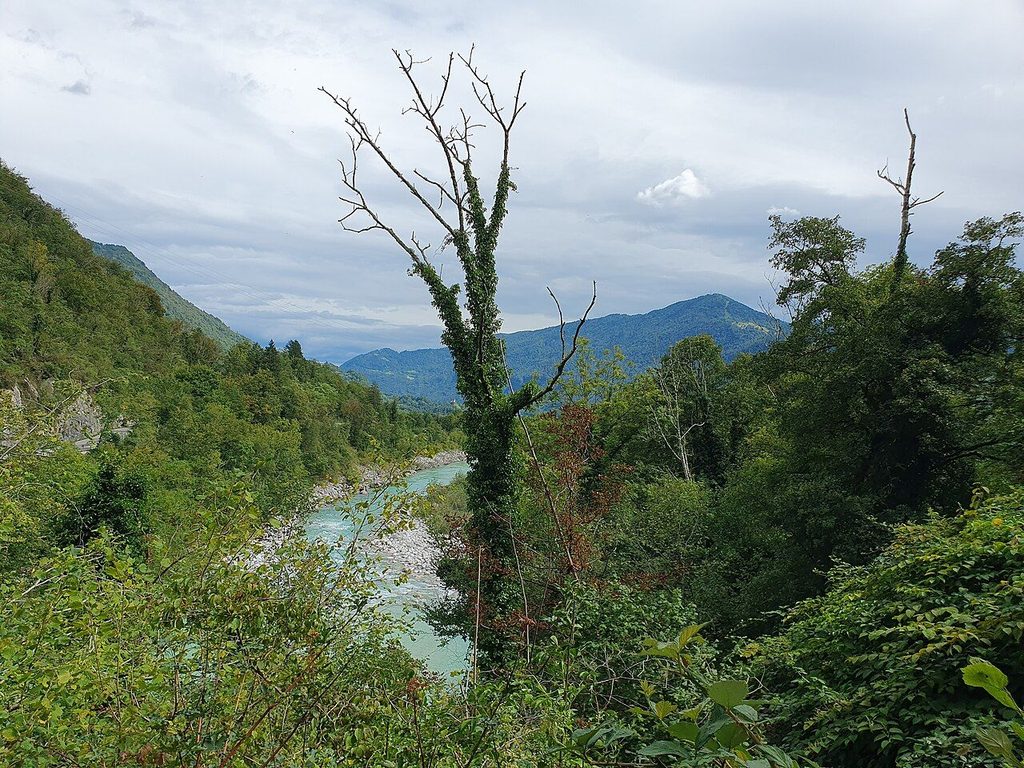
An emerald river running through limestone gorges, a small town with a heavy war history, and a mountain road with fifty bends to reach it all.
- Region Soča valley
- From Ljubljana Two to three hours by car
- Bring Warm layer, water shoes, rain jacket
Local note: The Vršič pass usually closes after heavy snow and in much of winter, and the river water stays very cold all summer.
The Soča is famous for its colour. Fed by mountain water and running over pale limestone, it turns an almost unreal green-blue in sunlight, and it keeps that colour for much of its route through western Slovenia. The valley it carves runs from the high Julian Alps down past Bovec, Kobarid and Tolmin towards Italy. It is a place for walking, swimming in very cold water, rafting and quiet villages, and for one of the most moving pieces of twentieth-century history in Europe.
Over the Vršič pass
The most memorable way in is from the north. From Kranjska Gora, the road climbs over the Vršič pass, at 1,611 metres the highest road pass in Slovenia, and drops down into the Trenta valley at the top of the Soča. There are fifty numbered hairpin bends, roughly half on each side, many still cobbled.
The road was built during the First World War, largely by Russian prisoners of war. A small wooden Russian Chapel on the northern side remembers those who died in an avalanche during its construction. Near the top, a stone face called the Ajdovska deklica, the heathen maiden, is visible in the rock wall of Prisojnik.
The pass is usually closed in winter and after heavy snow, and it is narrow and busy in summer. Drive slowly, use low gears on the way down and expect cyclists and motorbikes. If you prefer to avoid it, you can reach the valley from the south via Nova Gorica, or take the car train from Bohinj to Most na Soči.
The river from its spring
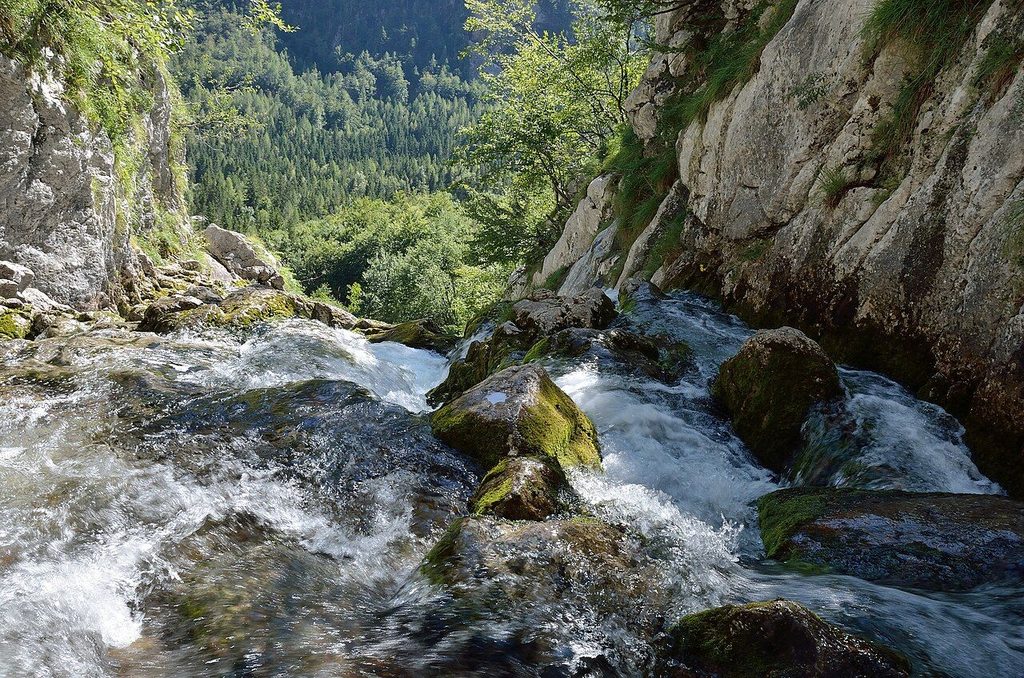
On the Trenta side of the pass, a short side road and a steep path lead to the spring of the Soča. The path is narrow and secured with cables in places; it ends where the water rises from a dark crack in the rock. Not far downstream the young river already rushes over boulders.
Next door: Škocjan and the Karst caves
From the spring, the Soča Trail (Soška pot) follows the river for about twenty-five kilometres down to Bovec, passing suspension bridges, small gorges and pools. You can walk any part of it and come back the same way. The Great Soča Gorge near the village of Soča is one of the most striking short sections, where the river squeezes through a slot only a few metres wide.
Bovec, in a wide basin below Kanin, is the main base for rafting, kayaking and canyoning. Operators are many; choose one with good safety standards and check what is included. Swimming is possible in calm pools, but the water is cold enough to take your breath away.
Kobarid and the Isonzo front
Between 1915 and 1917 the Soča, then called the Isonzo, was the front line between Italy and Austria-Hungary. Twelve battles were fought along it, in the mountains and the valley, with huge losses on both sides. The last, in October 1917, broke through near Kobarid, then Caporetto, and pushed the Italian army far back across the plain.
The Kobarid Museum tells this story through objects, letters, photographs and models of the terrain. It is small, clear and sober, and most visitors leave quietly. Above the town, the Italian charnel house around the Church of St Anthony holds the remains of thousands of soldiers. A historical walking trail from Kobarid links the charnel house, remains of trenches, the Kozjak waterfall and the Napoleon Bridge over the Soča in a loop of a few hours.
Elsewhere in the valley you find outdoor museums along old trenches and small military cemeteries. The Walk of Peace (Pot miru) connects many of these sites along the former front line.
Tolmin and further down
Lower down, at Tolmin, the Tolminka and Soča meet below a set of gorges with a short walking circuit, footbridges and a cave. Entry is charged in season. South of Tolmin the valley widens and the river slows behind dams, still green, on its way towards the Adriatic.
Planning your visit
- Two or three days let you drive the pass, walk part of the Soča Trail and see Kobarid without rushing.
- A car makes life much easier. Buses exist but are infrequent, especially outside summer.
- Combine the valley with Lake Bled and Lake Bohinj on a loop through the Julian Alps.
- Heading south, the road continues towards Nova Gorica and the Karst, a short drive from the coast at Piran.