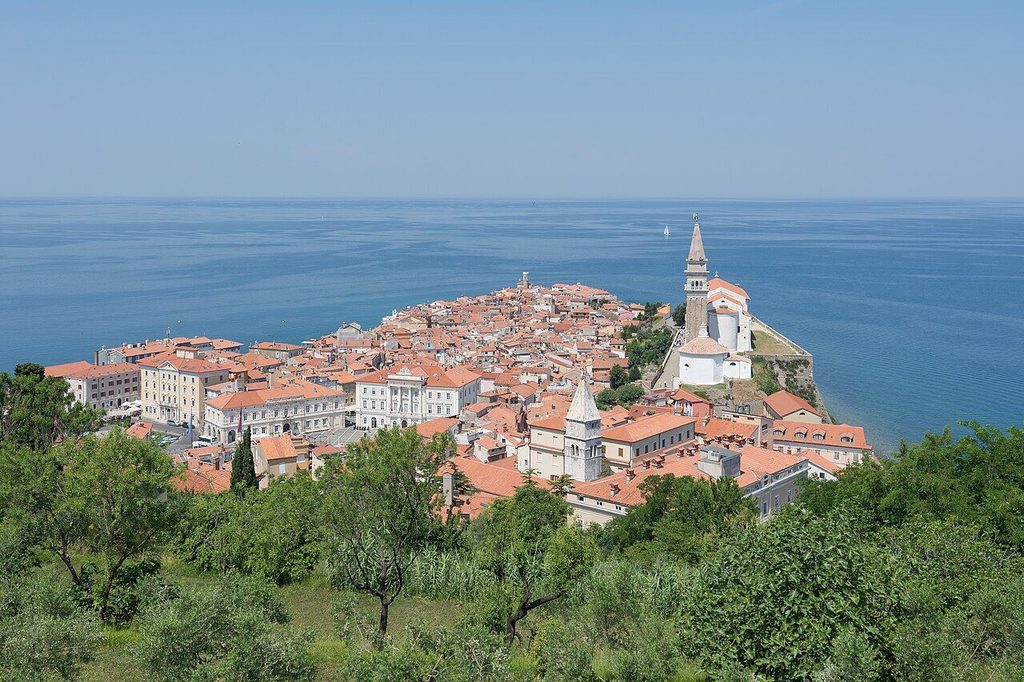
Slovenia has less than fifty kilometres of coast, and Piran sits at its tip: a Venetian town packed onto a narrow point between two bays.
- Region Coast
- From Ljubljana About two hours by car or bus
- Bring Sun hat, swimwear, comfortable sandals
Local note: Private cars are kept out of the old town. Use the large car park outside Piran and the shuttle bus in.
Piran sits at the end of a narrow point in the Gulf of Trieste, with the sea on three sides. For centuries it belonged to Venice, and it still looks the part: tall pastel houses, narrow lanes, a church on the hill with a bell tower copied from St Mark's, and a square that opens to the harbour. It is small enough to walk across in ten minutes and pleasant enough to stay for days.
Tartini Square and the old town
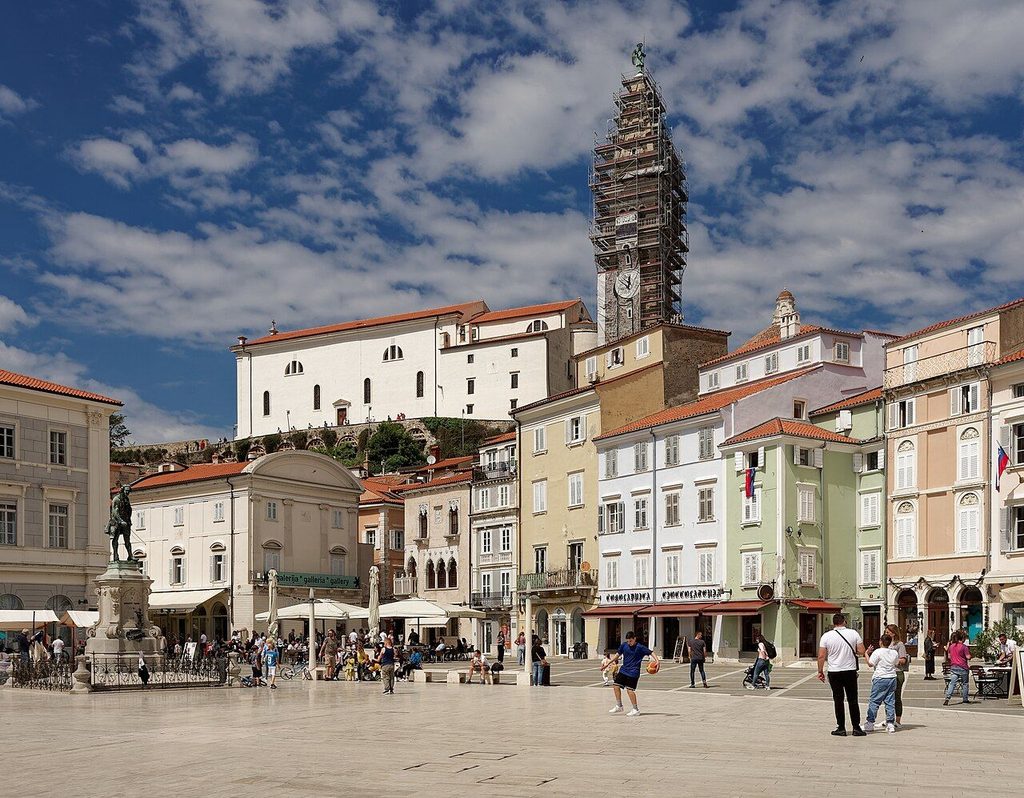
The heart of Piran is Tartini Square (Tartinijev trg), a wide oval of pale stone open towards the harbour. It was once an inner harbour for small boats, filled in during the late nineteenth century. At its centre stands a bronze statue of Giuseppe Tartini, the violinist and composer, born in Piran in 1692. His family house faces the square, and the red Venetian House, with its balcony and carved inscription, stands on one corner.
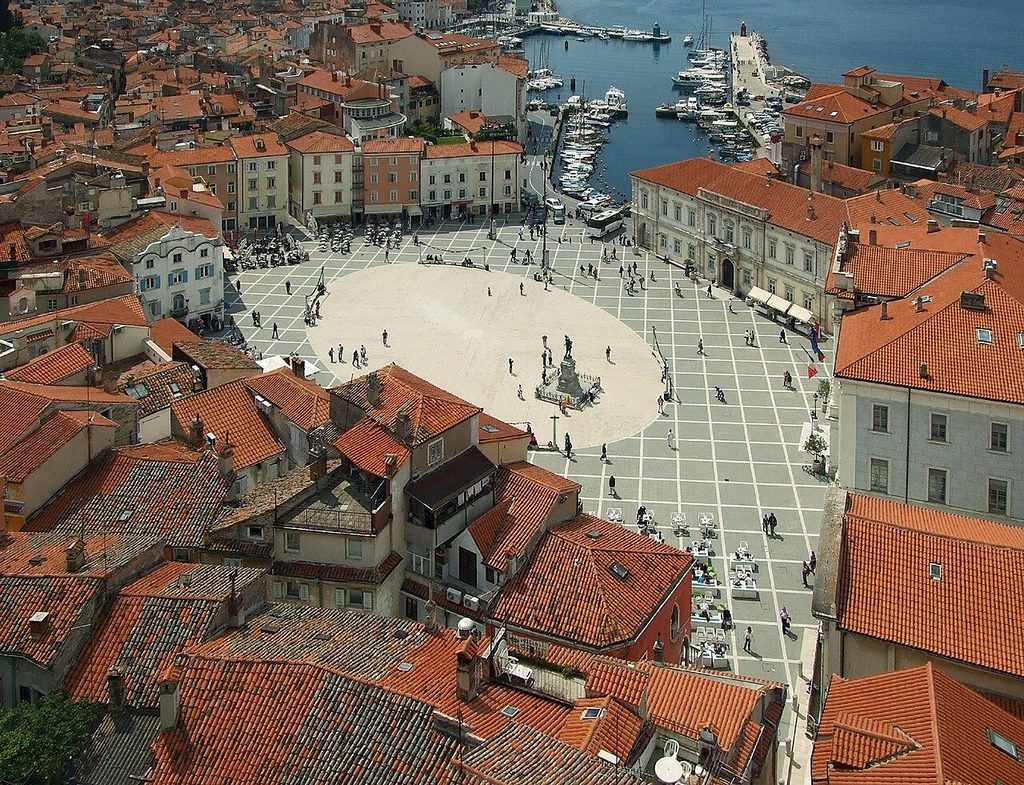
From the square, lanes climb and twist through the old town. Washing hangs between windows, cats sleep on steps and small squares open without warning. Walk out to the very tip of the point, called Punta, where a small lighthouse and the Church of St Clement stand at the edge of the water. On calm evenings people gather along the sea wall to watch the sun go down over the gulf.
St George's Church and the walls
The Church of St George stands on a ridge above the town, with a terrace looking straight down to the sea. Its separate bell tower was modelled on the campanile of St Mark's in Venice. Depending on works and the season, you may be able to climb the tower for a view over the roofs; the stairs are narrow and steep.
Further up the hill, sections of the old town walls survive, with battlements you can walk along. They give the classic view of Piran's red roofs and the point stretching into the sea, and on clear days you can see the Alps across the water. There is a small fee for the walls.
Next door: Škocjan and the Karst caves
Swimming and the sea
Piran has no big sandy beach. People swim from the concrete and rock edges along the promenade, using ladders into the water. The sea is clean and calm, and in summer the shore fills with towels from morning to evening. A path runs along the coast towards Fiesa, a small bay with two little lakes behind the shore, a quieter place to swim. Portorož, a resort town a short bus ride away, has a longer man-made beach.
The Gulf of Trieste is shallow and warms up well by July. Sea urchins live on some rocky stretches, so water shoes help.
The salt pans of Sečovlje
South of Portorož, close to the border with Croatia, the Sečovlje Salina Nature Park protects a wide flat area of salt pans at the mouth of the Dragonja river. Salt has been made here for centuries, and in part of the park it is still harvested by hand in the traditional way, in summer, with wooden tools. The other part is abandoned pans and old salt-workers' houses, slowly returning to marsh.
The park is also an important place for birds, with herons, egrets and many waders. You can walk or cycle on the dykes between the pans, and a small museum shows how salt-making worked. Entry is charged, and some areas have seasonal access. Go early or late in the day in summer, as there is little shade.
Buses to the coast
- Buses run from Ljubljana to Piran several times a day. By car, the motorway takes you most of the way; a vignette is required.
- Piran combines well with the Karst caves, which lie roughly halfway between Ljubljana and the coast.
- Summer weekends are busy. Spring and early autumn are warm, calmer and better for walking.
- Koper and Izola, the two other old coastal towns, are a short bus ride away and make an easy half day each.